
Two works from the ‘Holding Space’ Exhibition…
In February 2026, fine artist and craftsman Ruby Kester invited Alice Sheppard Fidler to discuss the two pieces of work she had shown in the group show ‘Holding Space’, in Bristol.
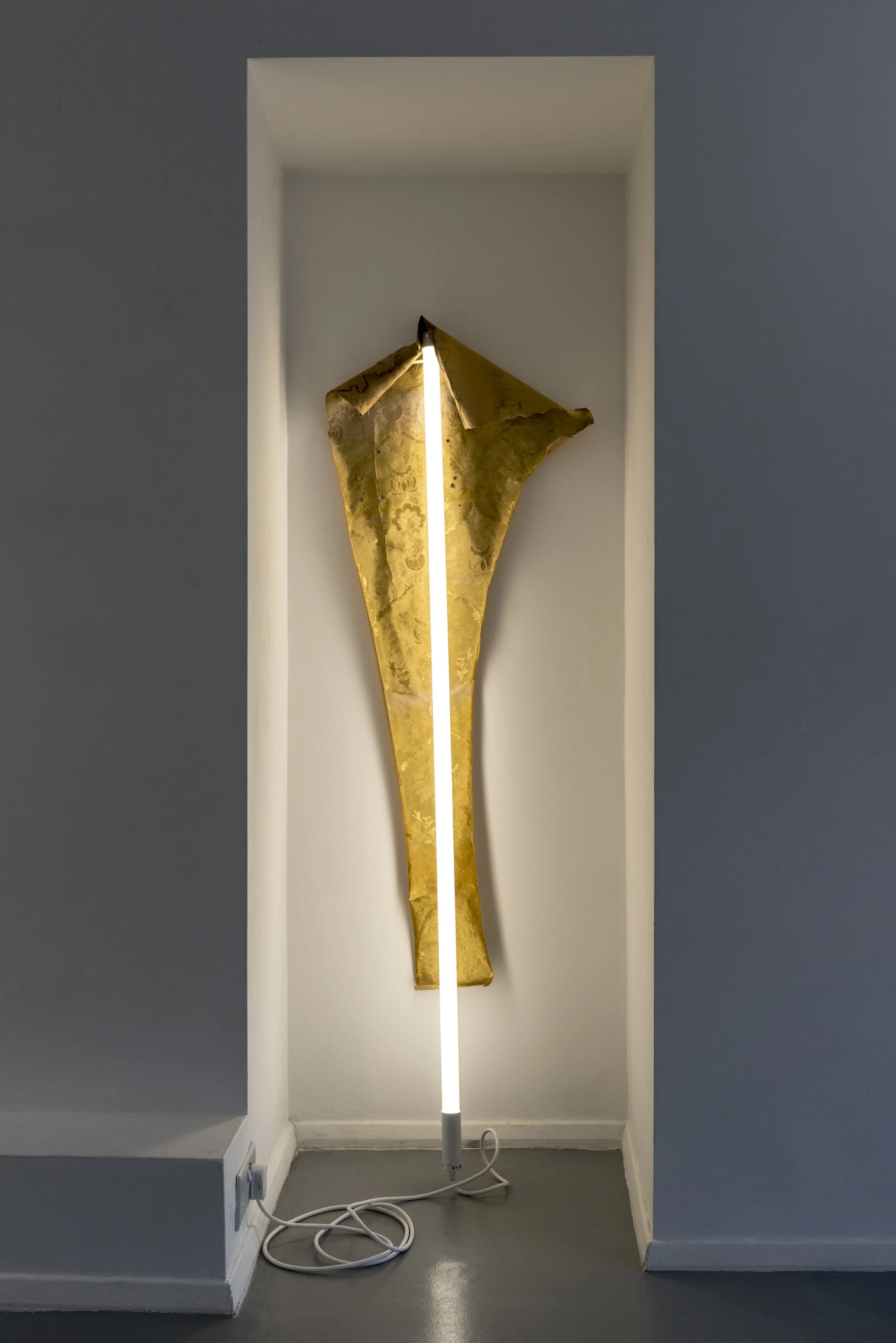
Once here, 2020 (Photo: Jo Hounsome)
Alice and I sat down with the intention of chatting through the connections between the works shown in the group show ‘Holding Space’, and how they interacted with the site they inhabited during the exhibition. With my prior knowledge of Alice’s work, I knew that ‘Holding Space’ as a title and concept relates directly to her practice - both the physical holding of space through architecture and design, and the metaphorical holding of space for ideas. ‘Once here’ (2020) is a light piece that was shown in an alcove where the light was both reflected off the walls around it, and contained by them. The piece ‘There, there’ (2025) is a mixed media sculptural piece where rapeseed by-product is held in a corner by two planks of wood, on the edge of spilling out.
Ruby: Did you feel a separation between the works in the show or was there a sense of relationship between them?
Alice: I hadn't anticipated the fact that there were five years between these works being made and that they are both made with two fundamental materials: one hard and one soft. They have these strong similarities to them: the wood and the light have different qualities, but the wood creates a firm boundary line and the white light also creates a defined line. There's a sort of relationship with architecture - one that requires the corner and one that speaks of architecture through its materiality.
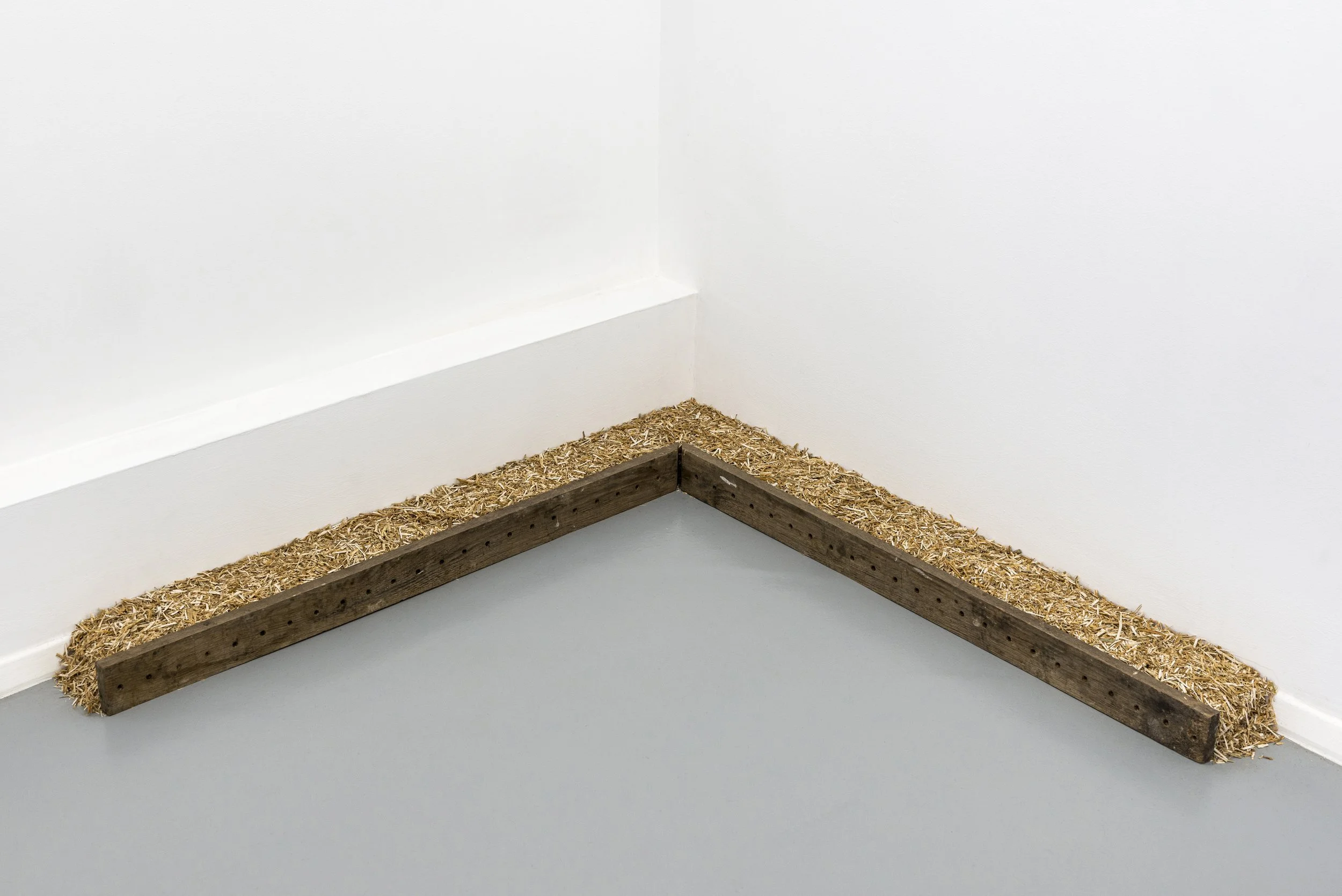
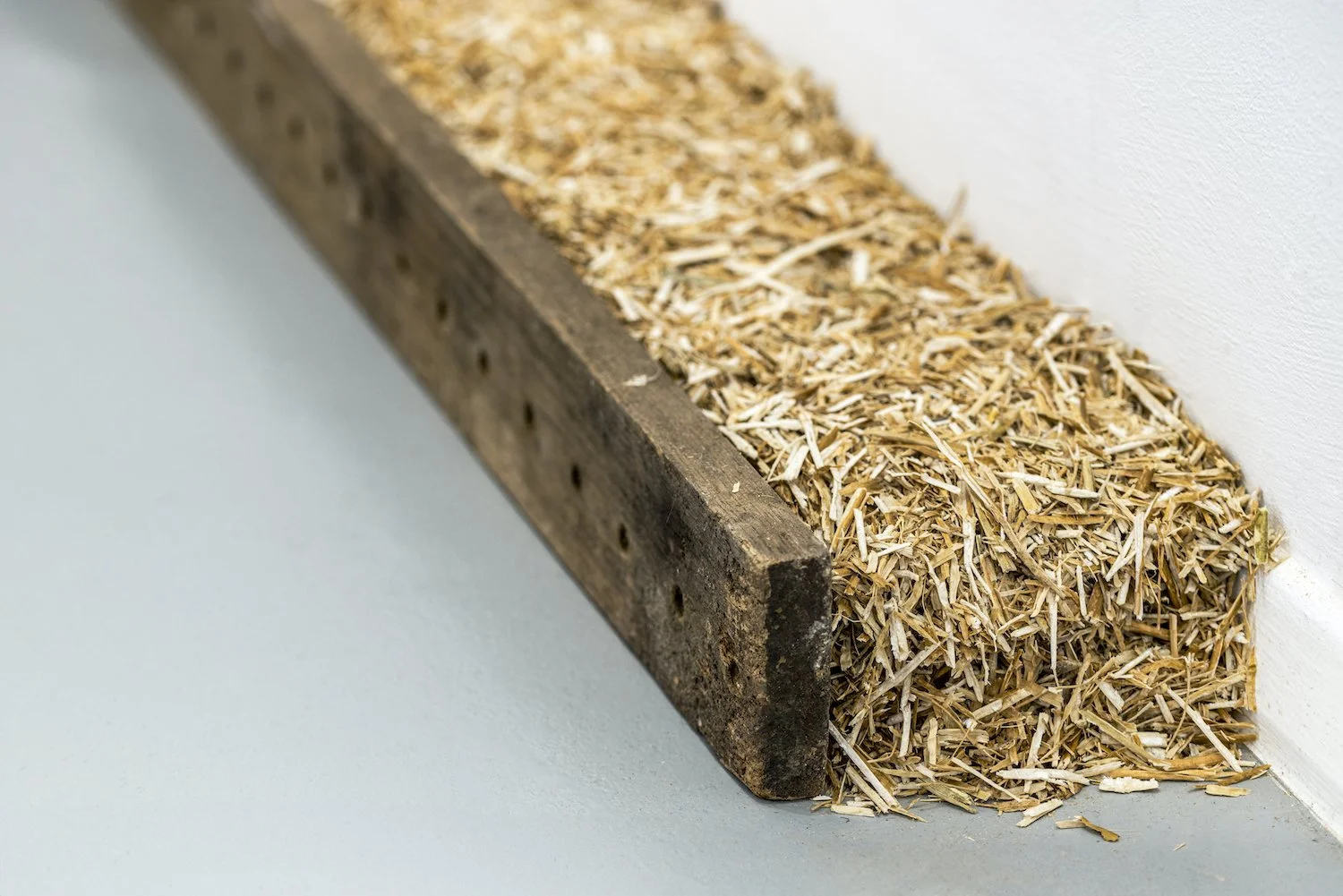
There, there, 2025
Ruby: With ‘Once here’ the whole space - the threshold, window or doorway into that vision - becomes part of the artwork. The reflected light on the walls ends up framing the piece, which you wouldn’t get outside of the alcove. It extends the boundaries of the artwork.
Alice: I would also say that it controls the boundaries. I like using light and sound in my practice because both light and sound travel as far as they can until something stops them. I’m playing around with this notion of control as utter expantion, freedom, tension until it bounces off something. So, the other thing we've got going in both works is control.
Ruby: I’d say in being in the alcove it relates more to the sense of control that I see with the wood. For example, I might say that the light is the equivalent of the rapeseed byproduct and the alcove edges the equivalent of the wood in some ways. Because of the control and the lines created, but also the way that the light could potentially spill out and the rapeseed byproduct, if you moved the wood, could also potentially spill out…
Alice: With these two works having come together coincidentally we now have a lovely essential list of what happens in my practice. This control, the notion of construction and deconstruction… Then there’s also a sense of place, time, and presence and absence. This piece of paper in ‘Once here’ I took out of my residency in the old brewery in Nailsworth. I love this aspirational wallpaper that was in a working man's club, that someone’s deliberately violated with this act of violence, puncturing. What drove somebody to think that they could stub their cigarette out on this beautiful wallpaper? So, we've got this bucolic, aspirational beauty, and nature with the waving fields of rapeseed that’re utterly otherworldly. Then I'm controlling it, or it has been ruined.


Ruby: Maybe it’s also a strange byproduct of human use, in that you were attracted to this wallpaper and it only exists in this way because a human interacted with it and burnt their cigarette up against it. It's being used by humans and discarded, and the byproduct of the rapeseed is also discarded. Humans take the good bit, freely picking and choosing the bits that they want and then just throwing away all the rest.
Alice: When you look at this work you know it's a found object and its speaks of another time. Just as with ‘There, there’ we know that the rapeseed is a living plant that’s now dead, so there's a history. It’s a double entendre of absence and presence where the thing that was done has created the hole that we're looking at now.
Ruby: Is the title of the work relevant?
Alice: ‘There there’ is called that because of the patting that I did for patting down the straw, which is a comforting action. But it's also from - and not coincidentally - Gloucestershire where I now live. I'm playing around with this idea of what we think is safe and secure. Always my work comes back to the great existential crisis of ‘do I exist’, ‘where am I’, in a playful, not too heavy way. The other thing that comes up in this work are the holes that are in the found wood, alluding to its past. The holes are similar to the cigarette holes. It's wood that has been functional. It had a reason and was purposeful, and the person sticking the cigarette into the wallpaper also had a purpose - but it wasn't functional, it was just playing around. This piece of wood would have been used for something, we just don't know what for and why they're even intervals. In the work they also act as indicators and pointers, because the holes run along the wooden structure and so your eye draws along them.
Alice’s work, through its use of found materials and its conceptual nature, speaks to something essential at the heart of human experience: the traces that the passing of time leaves on the world, the value of the forgotten and thrown away, and the emotions tied up in bearing witness to a life. Her work continues to be developed through site-specific residencies and exhibitions, and can currently be seen in the group show Stroud Sensation at Gallery Pangolin in Stroud, running through until the end of August.

You can find out more about Alice’s work here: Alice Sheppard Fidler - and Ruby’s here: Ruby Kester